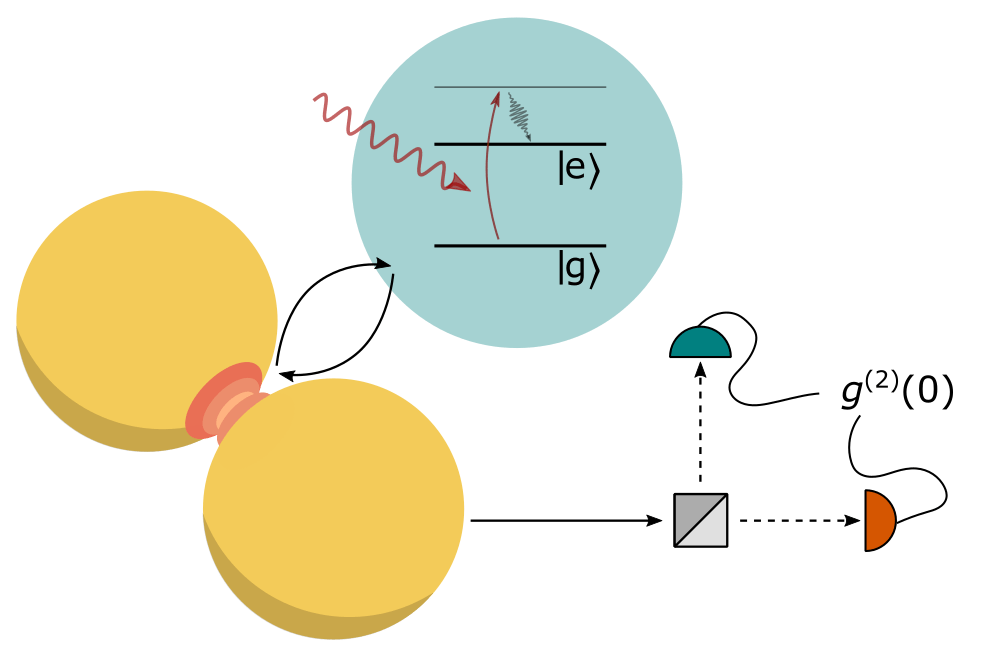
Work on using intensity correlations to probe the breakdown of the RWA and Jaynes-Cummings model out in PRResearch!

Our paper, discussed in some detail here:
https://mkschmidtphysics.blog/2022/12/01/new-prepring-on-the-intensity-correlations-in-ultra-strongly-coupled-systems/
is now published as Phys. Rev. Research 5, 043213 (2023). You can find a free version at arXiv:2306.15152 (2023) or contact me.

Group contributions at the upcoming conferences

Our group will be presenting several talks and posters at the conferences in November and December 2023:

  • at ANZCOP-AIP Summer Meeting (https://aip-summer-meeting.com/) our PhD student James Bainbridge will present his work “Taming the errors in nonlinear quantum optics” (coming the arXiv soon!); this will be James’ first oral presentation, so come and cheer him on on Wednesday, 17:45.

Finally, at the ANZCOP-AIP Summer Meeting I will be chairing two sessions:

  • “Coherences and Correlations in Australia: Celebrating 60 years of modern quantum optics” (https://aip-summer-meeting.com/focus-sessions/) – this focus session will feature two invited talks from Margaret Reid and Gerard Milburn, and 5 contributed talks,
  • “ANZCOP Optoacoustics & Optomechanics” with invited presentation from Chris Baker (UQ), and 2 contributed talks.

PhD opportunity: Quantum optics in GHz time-varying metamaterial

We are looking for motivated PhD candidates interested in joining our effort to explore how these new platforms can improve the capabilities of integrated quantum optical systems. The project will be mostly theoretical, framed in the language of open quantum systems, cavity optomechanics and quantum nonlinear optics. In addition, the candidate will work closely with a leading experimental group seeking to implement these concepts.

Prospective candidates need to contact the project supervisor: Dr Mikolaj Schmidt at mikolaj.schmidt@mq.edu.au by September 15 the latest to discuss the project, and submit the CV and academic transcript. We will invite selected candidates for online interviews in mid-September.

This PhD will be carried out under the joint supervision of three Sydney-based experts in quantum optical technologies:
– Dr Mikolaj K. Schmidt (https://mkschmidtphysics.blog/) and Prof. Michael J. Steel (https://researchers.mq.edu.au/en/persons/mike-steel) from the School of Mathematical and Physical Sciences at Macquarie University,
– A/Prof. Alexander Solntsev from the School of Mathematical and Physical Sciences, University of Technology Sydney (https://profiles.uts.edu.au/Alexander.Solntsev).

For more information, contact the project supervisor: Dr Mikolaj Schmidt at mikolaj.schmidt@mq.edu.au

This project would suit students with experience or interest in quantum optics, optomechanics, nano-optics, and numerical modelling.

You will formally join the group led by Prof. Steel at MQ. Note that both Macquarie University, and the University of Technology Sydney, are inclusive environments towards all cultures, genders, sexual orientations, age, and religions, and we warmly encourage enquiries from people of all backgrounds. In turn, we will expect you to embrace these values as a PhD student.
Preprint on the experimental realisation of Brillouin memory with ultra-short pulses on arXiv!

Our experimentalists colleagues from The University of Sydney (in collaboration with groups from the Australian National University and the Max-Planck Institute for the Science of Light) observed Brillouin memory (or light storage) using integrated chalcogenide waveguides and 150 ps optical pulses. In the experiment, the light was stored for 15 ns – a 100 times the length of the pulses!

In the new preprint “Brillouin light storage for 100 pulse widths,” posted on arXiv:2308.01009 we analysed those results, and provided some ideas for how to interpret the unexpected oscillations of the redout efficiency observed in the experiment.

Preprint on anharmonic effects in molecular optomechanics on arXiv!

Molecular optomechanics is a formalism that casts the Raman scattering from molecules in optical cavities as an optomechanical process. To date it was used to optimise the substrates for Surface-Enhanced Raman Scattering (SERS), propose new IR detection systems, and gain insights into correlations of the inelastically scattered photons.

Here we extend this formalism a bit further, by asking what happens when we account for the anharmonic mechanical potentials, which are characteristic for molecular vibrations. Can these be used to prepare exotic states of molecular vibrations? And do they modify the mechanical amplification that is the basis of SERS?

We now answer these questions in the new preprint arxiv:2306.15152, co-authored with Mike Steel.

Paper on electron spectroscopy using twisty particles (vortex electron beams) out in Physical Review Research!

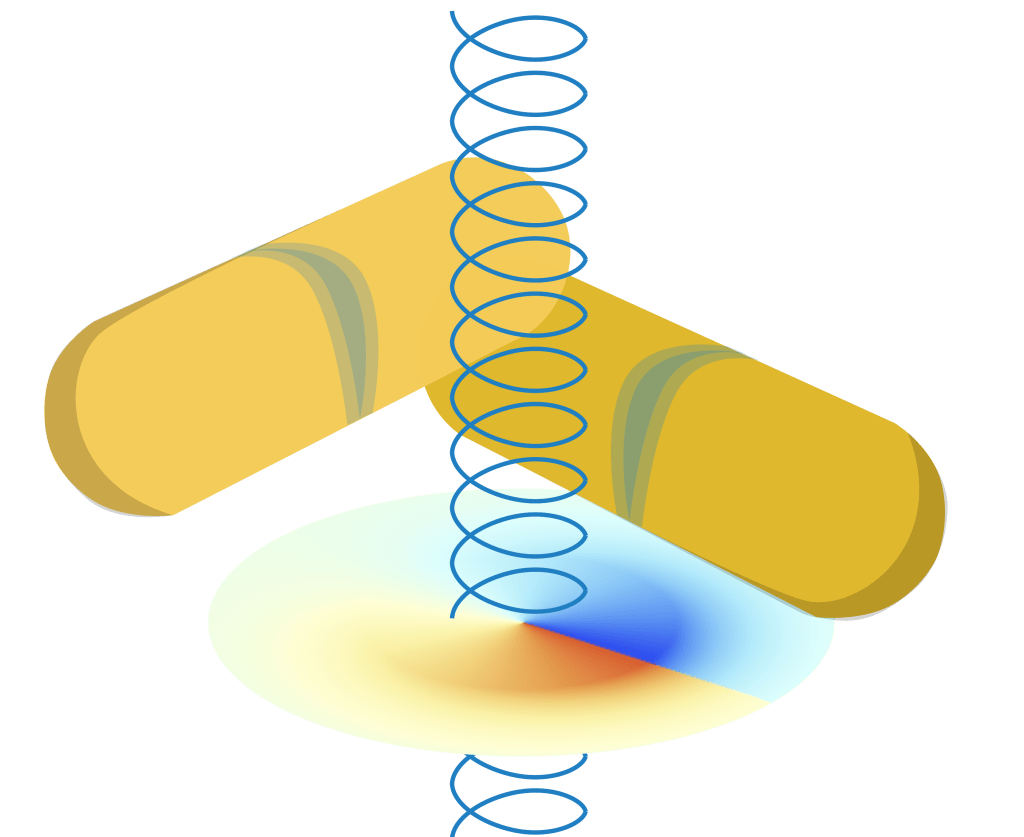
In electron microscopes, electrons are hurled at a velocity near the speed of light at materials or nanoparticles, to learn about the shapes, morphologies and optical characteristics. In particular, in Energy Electron Loss Spectroscopy (EELS), the energies of electrons before, and after scattering off nanoparticles are compared to contruct the spectra, and detailed maps of their optical resonances.

In a new twist on this technology, here we explore how EELS can be upgraded by pre-shaping the electron into the so-called Vortex Electron Beams (VEBs). VEBs are made up of electrons with substantial orbital angular momentum, and thus behave like little magnetic probes. We show that this new property allows VEBs to resolve the electric of magnetic character of the detected optical modes of nanoparticles. Furthermore, we demonstrate that, unlike the conventional electron beams, VEBs can readily characterize the dichroism of nanoscale system!

Our paper has just been published in PRResearch:

https://journals.aps.org/prresearch/abstract/10.1103/PhysRevResearch.5.023192

Group contributions at IONS KOALA and AIP

Ending 2022 with few conferences!

James, Shiro and Thomas are presenting their work at the IONS KOALA conference in Adelaide:

  • Shiromal Kumara, Michael J. Steel and Mikolaj K. Schmidt: Ensembles of quantum optical emitters,
  • James Bainbridge, Michael J. Steel and Mikolaj K. Schmidt: Quantum control of acoustic waves,
  • Thomas Dinter, Mikolaj K. Schmidt, Michael J. Steel: Anti-Resonant Reflecting Acoustic Rib Waveguides for opto-acoustics.

The following week, on top of these contributions, we’ll present a few more talks at the AIP Congree in Adelaide:

  • Álvaro Nodar, Ruben Esteban, Unai Muniain, Michael J. Steel, Javier Aizpurua and Mikolaj K. Schmidt: Statistics of light emitted from ultra-strongly coupled quantum systems, invited talk, (see blog entry on the recent preprint),
  • Mikolaj K. Schmidt, Daniel Burgarth, Gavin Brennen, Christopher G. Poulton, and Michael J. Steel, How to engineer optomechanical coupling using NV defects,
  • Oscar A. Nieves, Matthew D. Arnold, Mikolaj K. Schmidt, Michael J. Steel and Christopher G. Poulton, Modelling of noise in Brillouin-based storage and retrieval, (see blog entry on the recent papers),

and a poster from our recent graduate:

  • Saurabh Bhardwaj, Mikolaj K. Schmidt, Michael J. Withford and Michael J. Steel, Accurate modelling of femtosecond-laser direct written fibre Bragg gratings.

New prepring on the intensity correlations in ultra-strongly coupled systems

Spectrum of light emitted from a quantum system can tell us a lot about its dynamics, but to gain insight into its classical, or nonclassical nature, we need to measure other properties of the emission, like its intensity correlations.

In our new preprint Identifying unbound strong bunching and the breakdown of the Rotating Wave Approximation in the quantum Rabi model, in a work led by Alvaro Nodar from the Theory of Nanophotonics group in San Sebastian, we used the intensity correlations of light emitted from a quantum emitter-cavity system, to learn something about the breakdown of the Jaynes-Cummings model. Among other things, we learned that the intensity correlations are an extremely sensitive probe of this breakdown!