A couple of days ago I got my hands on “The Wisdom of Crowds” by James Surowiecki. The introduction (all 5 pages!) tells a fascinating story of how Francis Galton found that the mass of a fat ox, displayed at a local country fair, was remarkably well estimated by the average of bets submitted by the crowd of attendees of the fair (which by definition of “a “crowd”, included individuals with knowledge of livestock spanning from extensive to null. And back!) Furthermore, he found that this average was closer to the actual result than any individual bet!
Having read that story, I turned to Facebook to ask my friends to help me estimate whether the future president of the USA will be a donkey or an (orange) elephant. A true zoo of possibilities!
But my soon revised goal was to estimate how well will my estimate – biased by the geography and cultural homogeneity of the participants (majority of bids came from my facebook friends; there were very few shares and only 1 vote from an individual outside my friends list – hey Maren!) – compares with those conducted with thousand of votes, primarily residing in the USA.
The actual question, and the assisting disclaimers can be found near the end of this post.
Results
I plot the results below. Since overall Hillary Clinton won the poll, I show the ratio of bids favoring her (poll-winner bids) to the total number of bids (total bids).
As the votes were coming in, every few hours I would note the votes to see if tendencies are changing (note the slight uptick in the last hours – I closed to loop after voting in the USA has been going on for a few hours already; might be a coincidence though).
So, the blue line is a guide, but points represent the actual ratios measured at irregular time intervals. Orange line represents the final ratio of bids from Poland (11-8 for HC), red – final ratio of bids from Spain. The green area depicts highest and lowest betdata probability score from the BETDATA website taken over the last 2 days.
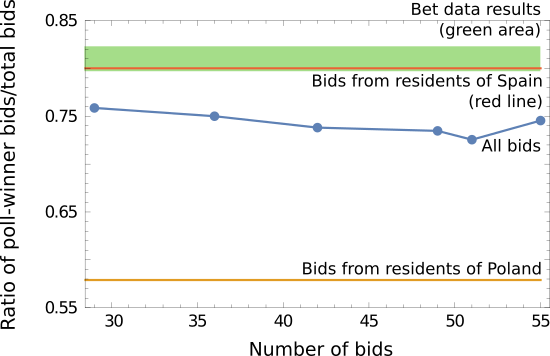
I chose to plot results from Poland and Spain, as these were the countries most frequently listed as residences – 19 (11H, 8T) and 5 (4H, 1T) times, respectively.
The remaining countries of residence were: Germany (4H, 0T), UK (3H, 1T), Netherlands, USA and Switzerland (all 2H, 0T), Austria, India, Israel, Egypt and South Africa (all 1H, 0T) and finally Denmark and Australia (both 0H, 1T).
Interpretation? Observations?
“Data! Data! Data!” he cried impatiently. “I can’t make bricks without clay.”
Sherlock Holmes
There’s actually to little data to come to any sensible conclusions. The trend is there, but… I don’t know. I was actually hoping to find that the “crowd” residing in Poland would provide identical estimate as the large polls. Well… you proved me wrong!
Interestingly enough, (the few) Spaniards were much closer.
Another point is that, while I stressed that this is not a popularity poll, some people did express their grief over the projected outcome. Among those residing in Poland, it was 3 bids for Trump assisted by grief, and 1 bid for Hillary, where Dorota (hej Dorota!) wrote “We all lose”. Hardly a cheer, right? So, perhaps it’s just that Poles are naturally more pessimistic? With this weather, can’t blame them… USA!
In a recent poll conducted in Poland, Hillary got around 60% of votes, whereas Trump got 6%. Mind you, this was a popularity vote, not a prediction of the outcome.
Actual results
I will update this post once the official results are in… in December 😉 Not that it matters really (the update, the actual results do matter, I would have that orange, thin-skinned sexist to take us back to the stone age because he didn’t bother to listen people that actually know how stuff works, when it works and why his GREAT ideas won’t work).
The original facebook post:
Dear Friends, Drodzy Przyjaciele, Estimados Amigos,
I’m running a small-scale version of Francis Galton’s test, and I need you to answer the following question:
Who do you think will win the coming presidential elections in USA?
(y) [comment: this stands for the iconic fb “like”] for Hillary
 for Trump (sorry, that’s the supposed to be the smiley face – any of them really)
The idea is that if I assemble a bit enough group of people, with the usual distribution of knowledge of politics (with few experts and the majority of casual voters), I should be able to predict the results of the elections better than the polls. It doesn’t matter if you have little idea about the subject – your vote may actually matter more!
And, as per usual – please share and vote!
Few disclaimers:
(i) this is not a poll of political preferences – the question is not “who would you like to win” nor “who should win”; as my sister pointed out accurately, it’s difficult to separate your informed guess from a political bias – to handle that issue, think of it as a casino gamble, where you have to bet $10000 on either candidate. No responsibility or pressure really  😉
😉
(ii) If you don’t mind, please share your choice and your country of residence in the comments. I may use it for some more advanced analysis later. Again – it’s not about you declaring your bias! Just how accurate of a guess you can make.
(iii) I’m taking the liberty of marking a lot of my friends here – I need to get as many votes as possible, and it turns out I’m not as popular as I though I was… 😉
(iv) I do know that there are many other polls like these. But this one is mine. Special. Like that little cactus I barely keep alive in my apartment. And I won’t compare it to all the other cactuses (cacti?!) until it blooms!
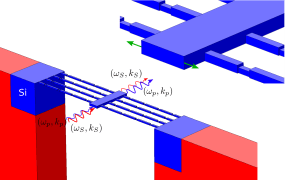 Our manuscript on novel design of mid-IR silicon waveguides for Brillouin scattering was just published in Optics Express (open access)! In this work we merge ideas from linear physics of mid-IR waveguides developed in the research groups of our co-authors – Profs. Goran Mashanovich and Graham Reed from The University of Southampton (click here for one of their reports), with the some phonon bandgap engineering to design novel waveguides operating in mid-IR (which is hard and attractive!), and exhibiting strong SBS gain.
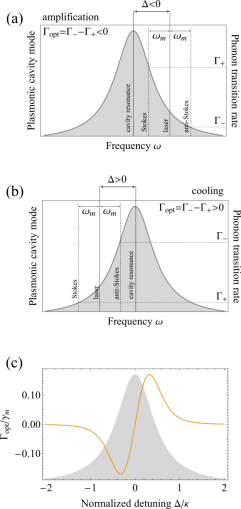
 analogue of the familiar electromagnetic concept – modification of the energy dissipation rate from a localized, dipolar source. In our study, the source in given by a localized harmonic force, and the modification of its radiation is governed by an elastic nanoantenna – a small spherical particle positioned near the emitter, and embedded in a different elastic material. We provide a theoretical framework for identifying the quasi-normal modes of the structure, demonstrate the effects in an exemplary system, and discuss the possibility of using this effect for engineering the rates of nonlinear, phonon-mediated optical effects.
 n preparing a contribution for the
  During my stay at Warsaw University I was invited by my host – Prof. Konrad Banaszek (who, BTW is moving to Center of New Technologies and starting a new project Quantum Optical Communication Systems) to give a seminar on the quantum-mechanical elements of my PhD work. Afterwards, I have had the pleasure to give another seminar (invited by Dr. Karolina Slowik who recently moved back to Torun and brought her expertise on the plasmon/quantum optics interface and starting project
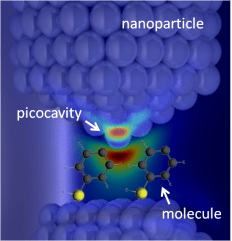
 Faculty of Physics of the Warsaw University… in Warsaw, Poland. I have been granted a Short Term Scientific Mission scholarship from the COST Action MP1043 “Nanoscale Quantum Optics”.
 Mikołaj K. Schmidt